Fish Taxidermy School - Student
Testimonials:
"This is an excellent teaching DVD! I learned so
much more about how to do taxidermy! Thanks for the fast delivery!" Glenn V
"I ordered this DVD for my
son. He has a dream of opening his own shop, and now he wants the other DVDs!
He is so excited!" Jan F
 On SALE $24.95 On SALE $24.95
Reg $29.95

DVD + FREE Shipping
or
INSTANT Download
Proper Field Care for Fish:
Fish
Taxidermy without a doubt begins with proper field care. If
your goal is to produce the best looking mount possible, make sure
you start with an fish that has had excellent care in the field.
This will greatly effect the quality of the finished mount. So
you have caught a mountable trophy fish, what do you do?
-
Never let the fish
flop around in the boat or cooler
-
Place the fish on
ice as soon as possible
-
When you get home,
measure your fish to order supplies:
A: Gill Plate to Base of Tail
B: Measure width of the eye in millimeters
C: Measure around the fattest part of the belly of the fish
-
Wrap your fish in a
very wet towel. This will protect the fins when frozen.
-
Place in a plastic
garbage bag, seal it tightly and freeze it at once.
Fish Reference and
Anatomy:
To understand fish taxidermy you must
first have a true understanding of the fish you are mounting.
The most valuable thing you can do is develop a library of fish
reference material. I started out with Bass because they were
plentiful in my area. You can start by clipping fish pictures
from fishing magazines and taking photos of the fish you catch.
One of the most valuable things I did was get a large aquarium to
place live fish in to study. This advanced my fish taxidermy
to a whole new level. Think of what I learned by watching a
live 6 lb bass. Keep as much of your fish taxidermy reference
material at your work area as possible. As you mount your
fish, study each area with your reference. See how close you
can come to duplicating a live fish. Do the same thing when
painting your fish. Develop the habit of trying to duplicate a
living fish every time you sit down to work. This will help
you in becoming a Master at Fish Taxidermy.
Among professionals, it is generally
agreed that the most difficult branch of taxidermy is fish
mounting. Creating a technically accurate fish mount can be a
real challenge. The top award-winning fish taxidermists are
almost all outstanding flat artists as well. The ability to
draw, paint, mix colors, and sculpt are shared among most of the
world's best fish taxidermists.
Mounting fish not only requires the ability to accurately
recreate the anatomy of the subject, but to restore all of the
colorations as well. When a fish skin dries, most of the color
goes away, leaving only brownish patterns on the skin and
scales. Fish taxidermy is the one area of wildlife art where the
artist must totally recreate the colors of the skin all over the
animal. In bird taxidermy, the taxidermist must paint the legs,
feet, and bill, but the feathers retain their natural colors. In
mammal taxidermy, the taxidermist must paint the nose and eyes,
but the fur requires no color correction. In fish taxidermy,
however, the taxidermist has to paint every square inch of the
specimen, and make it appear natural.
There are a lot of different ways to produce a fish mount, and
fish taxidermists usually are required to choose different
mounting methods to match their particular subjects.
Warm water fish with tough skins and large scales (such as bass,
crappie, and bream) are good candidates for skin mounts. A skin
mount means that the fish is skinned, the skin is preserved, and
the skin is either mounted over a mannikin, or the fish's body
cavity is packed with a filler material which is shaped and then
allowed to harden. These types of fish are not particularly
greasy, so they are usually mounted with the natural skull still
attached to the skin. The fins and tail are also the real thing.
Cold water fish such as trout, salmon, and char have thin,
smooth skins with fine scales. Their skins and bones are also
more greasy than their warm water cousins. Mounting these fish
is a bit more difficult because any lump of mache or hide paste
under the skin can be visible. The preferred method for mounting
these specimens is over a smooth foam mannikin. The natural
skulls are sometimes used, but due to increased problems with
shrinkage, spoiling, and grease bleed-through, many taxidermists
use artificial heads (cast in polyester resin) attached to a
natural skin-mounted body.
Most saltwater fish (as well as many cold water fish) are
entirely recreated from man-made materials. Without question,
these synthetic mounts are the most long-lasting taxidermy
renderings. While the fish is fresh, a carefully constructed
mold of the fish is made. Then, the body and fins of the fish
are cast in fiberglass reinforced polyester resin. The mold of
the fish is called a fiberglass "blank" at this point, because
it has no markings or color. The taxidermist must entirely
create the coloration on the mount to make it appear like a live
fish.
Due to the restrictive costs of molding and reproducing
fiberglass gamefish, it is not commercially feasible to make a
special mold for every sportsman's catch, nor is it necessary.
Taxidermists found out years ago that one 84" sailfish was
shaped pretty much like any other 84" sailfish. A new industry
was born as taxidermists with a good selection of fish molds
started constructing multiple reproduction fish from their
molds. These fiberglass fish blanks are sold to other
taxidermists throughout the country who only have to prepare the
fish and paint it to convincing coloration.
Fiberglass reproductions are gaining in popularity. They are
ideal for use on difficult species to mount: large fish, greasy
fish, or fish which are difficult to skin, such as catfish. They
are also great for catch and release programs or other
conservation methods. Another advantage is the longevity of the
mount. A fiberglass reproduction could conceivably last for
thousands of years. They are practically indestructible.
|















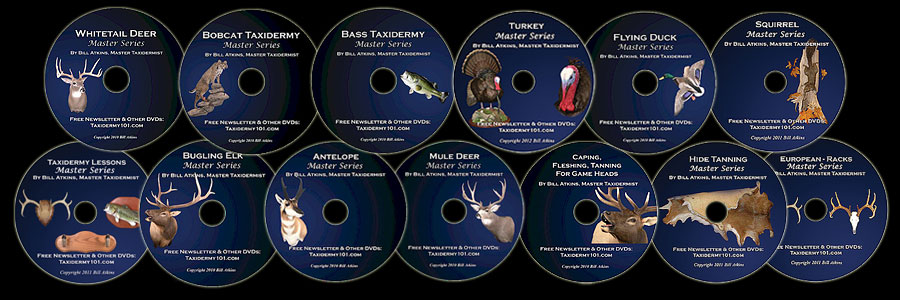
 This
complete 2-hour, start-to-finish
Fish Taxidermy Instruction DVD
teaches Bass Taxidermy and is perfect for beginners. Learn these easy steps
from home and you will have a fun
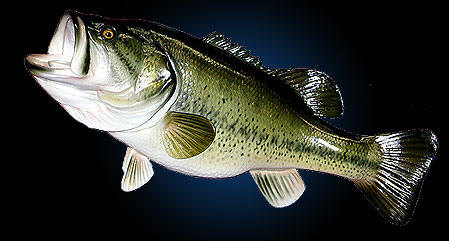
hobby or business you will enjoy for years to come. Although the Fish Taxidermy
DVD demonstrates mounting a Largemouth Bass, mastering these techniques will
greatly aid you in mounting other fish such as Small-mouth Bass, Trout, Perch,
Crappie, Bream and other skin-mountable fish.
This
complete 2-hour, start-to-finish
Fish Taxidermy Instruction DVD
teaches Bass Taxidermy and is perfect for beginners. Learn these easy steps
from home and you will have a fun
hobby or business you will enjoy for years to come. Although the Fish Taxidermy
DVD demonstrates mounting a Largemouth Bass, mastering these techniques will
greatly aid you in mounting other fish such as Small-mouth Bass, Trout, Perch,
Crappie, Bream and other skin-mountable fish.